
Microsoft Fabric
How many customers do you have? Agreeing shared definitions for 2027
Sales, Finance and Service can each report a different number of customers and all be right. Why shared business definitions are a 2027 data priority, what AI tools do without them, and how to agree terms once and build them into Power BI.

Published
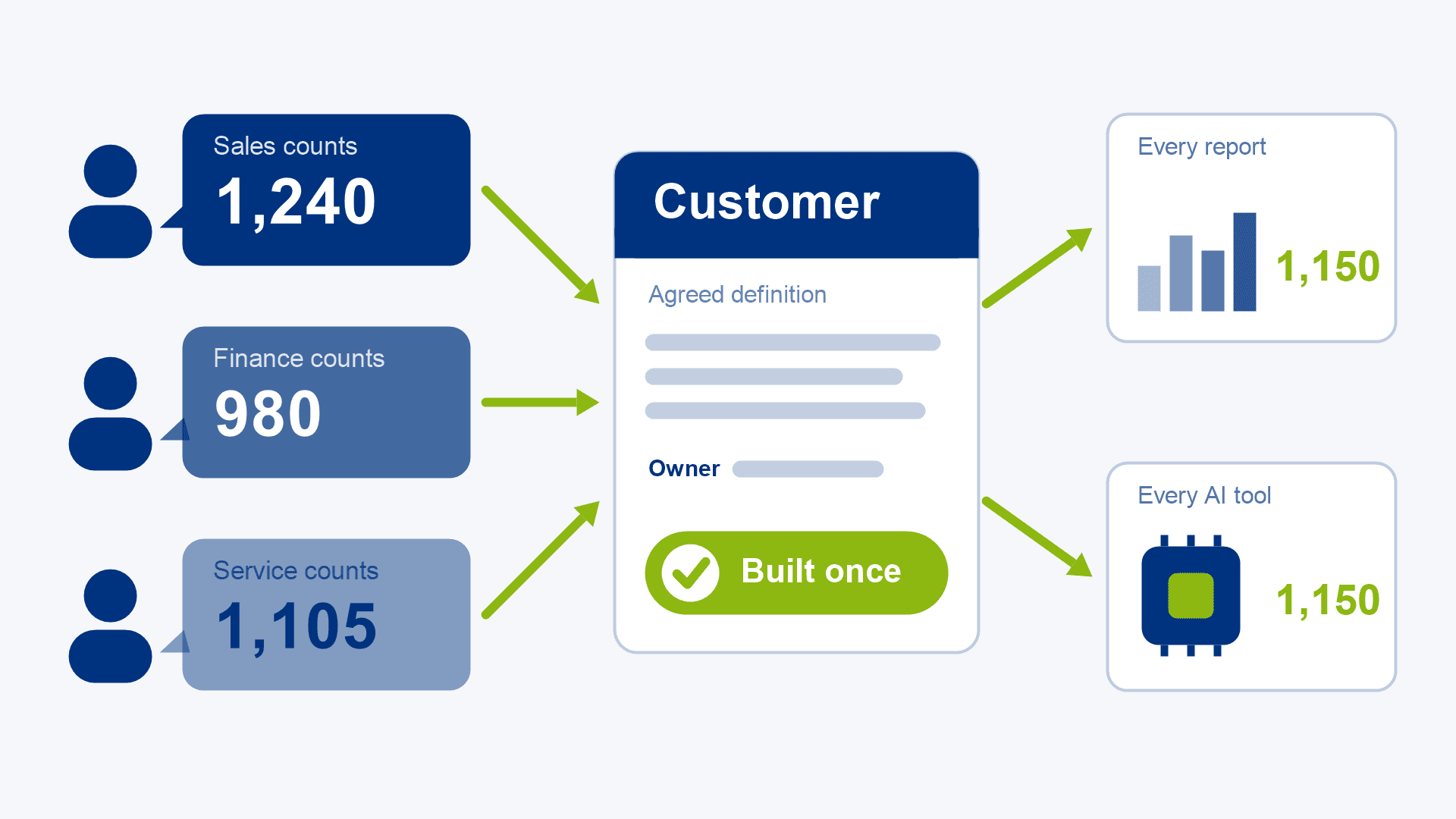
Different departments often count the same thing in different ways, so reports disagree even when each one is correct. AI tools make this worse, because Copilot or an agent will use whichever definition it finds. The fix is mostly about people: agree your key terms with the people who own them, write them down, then build each one once in a shared Power BI semantic model that every report and AI tool uses.
The board pack arrives on Monday. Slide four says the business has 1,240 customers. The finance appendix says 980. The service report, attached for a different item, says 1,105. Twenty minutes of the meeting goes on working out which number is right, and the answer turns out to be all three. (These are example figures, but most finance directors will recognise the meeting.)
Sales counts anyone with an open opportunity. Finance counts anyone invoiced this year. Service counts anyone with an active contract. Nobody made a mistake. They are measuring different things under the same name.
It is a bit like ordering a pint in London and then in New York. Both bars serve you a pint, and both are right by their own standard, but the British pint is about 568ml and the American one about 473ml. Nobody notices until someone compares the glasses.
Why do different reports give different answers to the same question?
Quick Answer: Reports disagree when departments use the same word for different things. Each team defines terms such as customer, revenue or active around its own work, and builds its reports that way. Every figure can be correct by its own rules, which is why the problem survives audits and only shows up when two reports sit side by side.
The causes we see most often on client projects are:
- Different rules behind the same word. "Revenue" may mean invoiced, recognised or booked. "Customer" may mean ordered once, ordered this year or holds a contract.
- Different time periods. Calendar year in one report, financial year in another, a custom 13-period year in a third.
- Different filters. One report excludes internal accounts or shared services; another includes them.
- Calculations copied into spreadsheets. Once a formula is copied, each copy can drift on its own.
We covered the background in Why a Single Business Dictionary Drives Clarity, including a retail client where Sales, Marketing and Finance each defined a customer differently.
Why do shared definitions matter more once AI is involved?
Quick Answer: A person reading two reports can spot that the numbers differ and ask why. An AI tool usually cannot. Copilot or an AI agent answers from whatever measures and tables it can reach, so if "customer" is defined three ways, it may pick any of them and give a confident answer that one department will dispute.
Research firms have noticed. Info-Tech Research Group's Data Priorities 2027 puts building shared business definitions that work for people and AI first among its five priorities for data leaders. BARC's Data, BI and Analytics Trend Monitor 2026, which surveyed 1,579 users, consultants and vendors, ranks data quality management first of 20 trends. Agreed definitions are part of what makes data trustworthy in the first place.
Microsoft's own guidance for preparing a Power BI semantic model for Copilot points the same way. You can add descriptions, synonyms and AI instructions to tell Copilot what your terms mean, but those settings sit on top of the model. If the measures underneath are wrong or duplicated, the instructions cannot fix them.
That is why we ask clients one extra question before they switch on Copilot: if someone asks it how many customers you have, which number should it give?
Who should decide what a business term means?
Quick Answer: The business should decide what a term means, and the data or IT team should build and maintain it. Give each key term a named owner, usually the person whose department relies on it most, and agree who settles disputes when two departments disagree. Write the decision down where everyone can find it.
In practice that means:
- A named owner for each key term. Often the Finance Director owns revenue and margin, and the Sales or Customer Director owns customer.
- A tie-breaker. When two owners disagree, someone senior decides. Without one, the argument returns every quarter.
- A written definition. A business glossary or data dictionary, in plain English, with the rule, the time period and any exclusions.
- A technical home. The data or BI team builds the agreed definition into the model and changes it only when the owner agrees.
Where two departments need different views, keep both, but give them different names. "Active customers" and "Invoiced customers" can live side by side. Two different things both called "Customers" cannot. As with the two pints, both measures are fine as long as the label says which one you are getting.
How do you agree definitions without a long governance programme?
Quick Answer: Start small. Pick the five terms that appear most in board reports, get the people who own them into a workshop, and agree a written definition for each one. Then build those five once and retire the copies. You can widen the glossary later, once people see the first few terms holding.
This is the approach we took with a client whose Finance and Project Management teams produced different Project Profit figures every quarter. Finance reported £1.6 million on an accrual basis with full overhead loading. Project Management reported £1.2 million based on milestone billings, excluding shared services. Aligning the two took three to four days every month.
We secured buy-in from Finance, Project Management and IT, then ran Data Dictionary workshops to agree precise definitions for Profit, Costs and Overhead. Project Profit was then defined once, as invoiced revenue minus direct costs plus a fixed overhead rate, tied to the corporate financial calendar. Monthly reconciliation dropped from four days to under an hour, and ad hoc data requests fell by 94%. You can read the full story in How We Used Unified Reporting to Align Finance and Project Management.
The workshops did not need a governance framework first. They needed the right people in the room and a decision at the end.
How do you build agreed definitions into Power BI and Microsoft Fabric?
Quick Answer: Build each agreed definition once, as a measure in a shared Power BI semantic model, and point every report at that model instead of recalculating in each report or spreadsheet. In Microsoft Fabric the same model can serve reports, Excel, Copilot and data agents, so a change to a definition flows everywhere at once.
The steps we follow:
- One shared semantic model holding the agreed measures and hierarchies, rather than a model per report. OurSemantic Modelling and Business Logic article walks through it.
- Descriptions on every key measure, using the wording from the glossary, so people and Copilot see the same definition.
- Endorsement, so people can tell the certified model from someone's copy.
- Copilot preparation: synonyms and AI instructions that map the words your people use to the right measures, tested against the questions your board actually asks.
- Governance in Microsoft Purview, where the glossary, data owners and lineage need a home across the wider estate.
For AI tools beyond Power BI, our AI Readiness and Data Foundations work models your business concepts and rules as semantic models and Fabric ontologies, so any AI tool reasons in your language rather than in table names.
Where should you start?
Quick Answer: Start with the question your business is asking. If reports already disagree, start with a definitions workshop and one shared model. If AI is about to be switched on, test the semantic model against your top questions first. If you are not sure how widespread the problem is, a short data discovery will show you.
If your situation is... | Start with | What you come away with |
Board reports disagree on key figures | A definitions workshop with the term owners | Agreed, written definitions for your top terms |
Definitions agreed but held in spreadsheets | A shared Power BI semantic model | Each measure built once and used everywhere |
Copilot or agents about to go live | Copilot Readiness or an AI Readiness Assessment | A model tested against your top questions |
Not sure how far the problem goes | Data Discovery | Findings and a prioritised plan you keep |
Glossary needed across the whole estate | Data governance with Microsoft Purview | Owners, glossary and lineage in one place |
What should you do this week?
- List the five terms that come up most in your board reports.
- Check whether each one is written down anywhere, and where.
- Ask who decides when two reports disagree. If nobody knows, that is your first decision.
- Find out whether the agreed version is built into your Power BI semantic model or lives in someone's head.
- Ask your AI tool how many customers you have, and see which number it gives.
If you would like help, our data governance and Power BI consultancy teams run definitions workshops and build the shared model. Call PTR on 0118 979 4000 or use our contact page, and tell us which term causes the most arguments in your organisation.
Shared definitions are one of four priorities in our Data priorities for 2027 research.
MD
Mandy Doward
Managing Director
PTR’s owner and Managing Director is a Microsoft certified Business Intelligence (BI) Consultant, with over 35 years of experience working with data analytics and BI.

Frequently Asked Questions
Couldn’t find the answer you were looking for? Feel free to reach out to us! Our team of experts is here to help.
Contact Us